Aug 2026
Garmin Golf: From Information to Decision Support
Overview
I have used a Garmin golf watch for years, originally relying on it mostly for distance. After switching from the Approach S42 to the S70, I started using more of the information available on the course, from PlaysLike distance to course maps and hazards.
As I paid more attention to how I actually use the watch during a round, I became interested in how it had become part of the way I play.

From S42 to S70
I had been using a Garmin Approach S42, and for a long time, distance was all I really needed from it. As I got better at golf, that started to change.
I wanted to see where hazards were, where a certain distance would land, and where to aim to set up my next shot. As my game improved, the information I needed on the course grew with it.
How the Watch Fits Into My Round
During a round, the watch is the only digital interface I use. At the tee box, I usually check what sits around my expected landing distance. If my driver goes around 160 yards, I zoom into that area of the map to look for water, bunkers, or a safer place to aim.
If my usual landing area puts me near a hazard, I may choose a shorter club instead. On longer holes, I use the same approach to plan where I want my next shot to land.
I am not just checking how far away something is anymore. I am using distance to decide where I want the ball to land.
Example: Using distance and the course map to decide where I want my approach shot to land.

Distance Became Context
With the S42, I would look at the distance and adjust for elevation myself. I knew an uphill shot needed more club, but I didn't really know by how much.
With the S70, I mostly look at the PlaysLike distance instead. If the actual distance is 130 yards but Garmin adjusts it to 140, I can simply choose the club I normally hit for 140.
Instead of estimating how elevation might affect my shot, I can make the decision from a distance I already understand.
After the Round
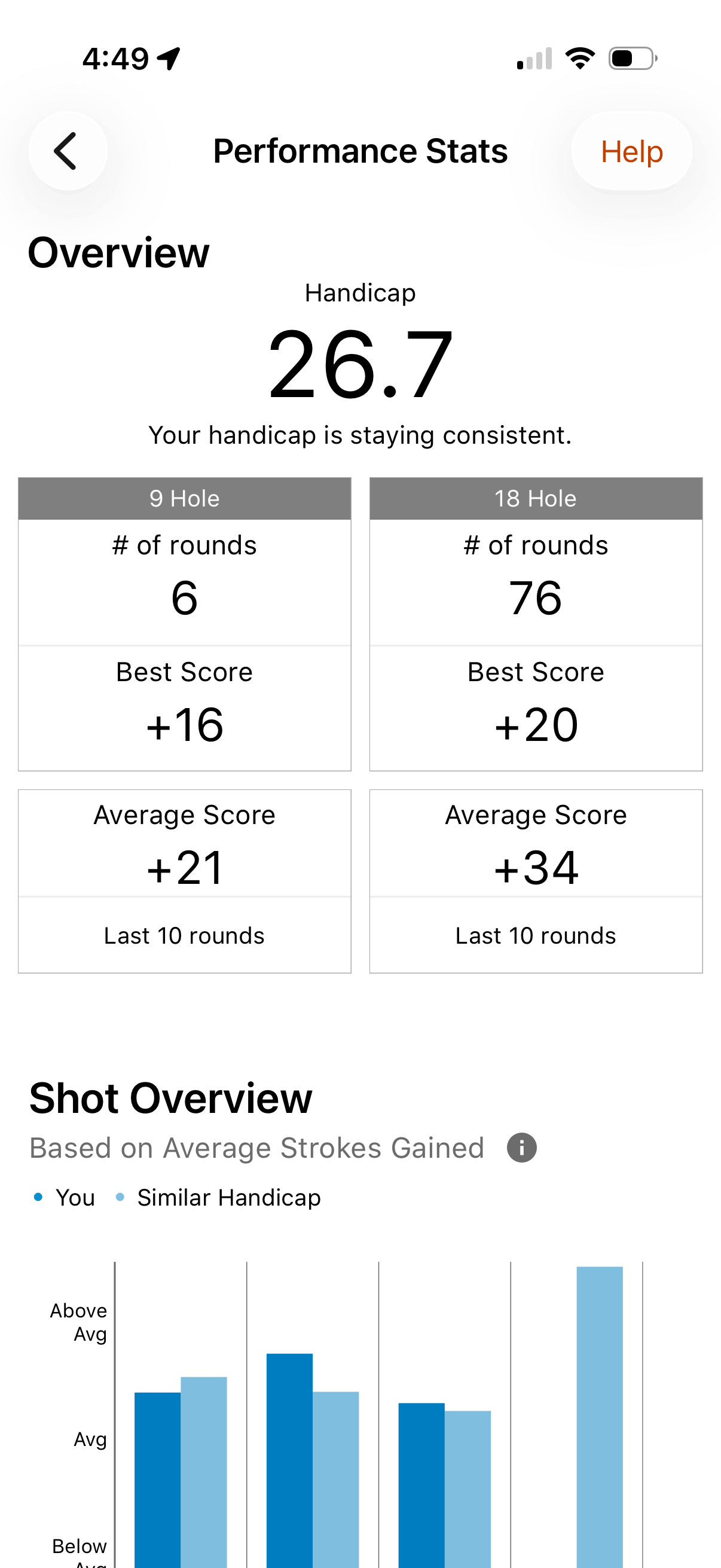
I usually open the Garmin Golf app right after a round, either on the way to eat or at the restaurant. I check my score, handicap, putting, and compare my GIR and fairway hits with my previous few rounds.
I also like going back to the hole maps, especially the ones where I played well. I replay the shots and look for anything unusual, like a drive that went farther than I normally hit. I rarely revisit the bad holes unless the score was bad enough that I want to understand what happened.
The post-round data is partly how I measure progress, but also how I replay the parts of the round I want to remember.


WHERE I STILL RELY ON MYSELF
Even with more information from the S70, I still make the final decision myself. Garmin helps me understand the distance, elevation, hazards, and what is around my target landing area, but I decide where to aim and which club to use.
The watch can also recommend a club through Virtual Caddie, but I rarely pay attention to it because I usually already have a choice in mind.
What Garmin knows about the course becomes useful when I combine it with what I know about my own game.
Example: Planning a Par 5 second shot
Hole layout
Hazards around 140 yd
Distance remaining
Garmin shows me
My 5 wood ≈ 140 yd
I tend to pull left
Where I feel comfortable aiming
What I know about my game
My decision
5 wood + Aim right to account for my tendency to pull left

KNOWING WHEN TO LOOK
I do not check the S70 before every shot. If the fairway ahead is clear and I still have plenty of distance to go, I usually just hit. When I need an exact distance or more context around my landing area, I check the watch.
The amount I interact with Garmin depends on how much I can confidently read from the course myself.
No interaction
I can read the shot
Clear Fairway
Plenty of Distance
Just play
Light interaction
I need a specific distance
Approach shot
Exact distance matters
Quick glance at Distance / PlaysLike
More interaction
I need more context
Hazard near landing area
Layup decision
Check map
Target distance
Hazards around landing area
Final Reflections
What started as a simple tool for checking distance has gradually become part of how I read the course. What I find interesting is that this has not meant interacting with it more. Sometimes I need a map, sometimes I need one number, and sometimes I do not need the watch at all.
The S70 feels most integrated into my game when it gives me what I need in the moment, then lets me get back to playing.
Read Next 👉